Entry Requirements
Visa requirements for Bolivia depend on which passport you hold. Check the Traveller visa tool to see whether your passport needs a visa and, if so, how long you can stay.
Check if you need a visa for BoliviaEmergency Numbers
- General
- 110 (police)
- Ambulance
- 118
- Fire
- 119
Currency
- Name
- Bolivian Boliviano
- Code
- BOB
- Symbol
- Bs
ATMs in La Paz, Sucre, and Uyuni. USD widely accepted at hotels and tour operators. Cash preferred in markets and local restaurants. Street money changers exist but use licensed exchange offices.
Power Outlets
- Outlet types
- Type A, Type C
- Voltage
- 220V/110V (varies by region)
- Frequency
- 50Hz
Time Zone
BOT (UTC−4) — no daylight saving
Best Time to Visit
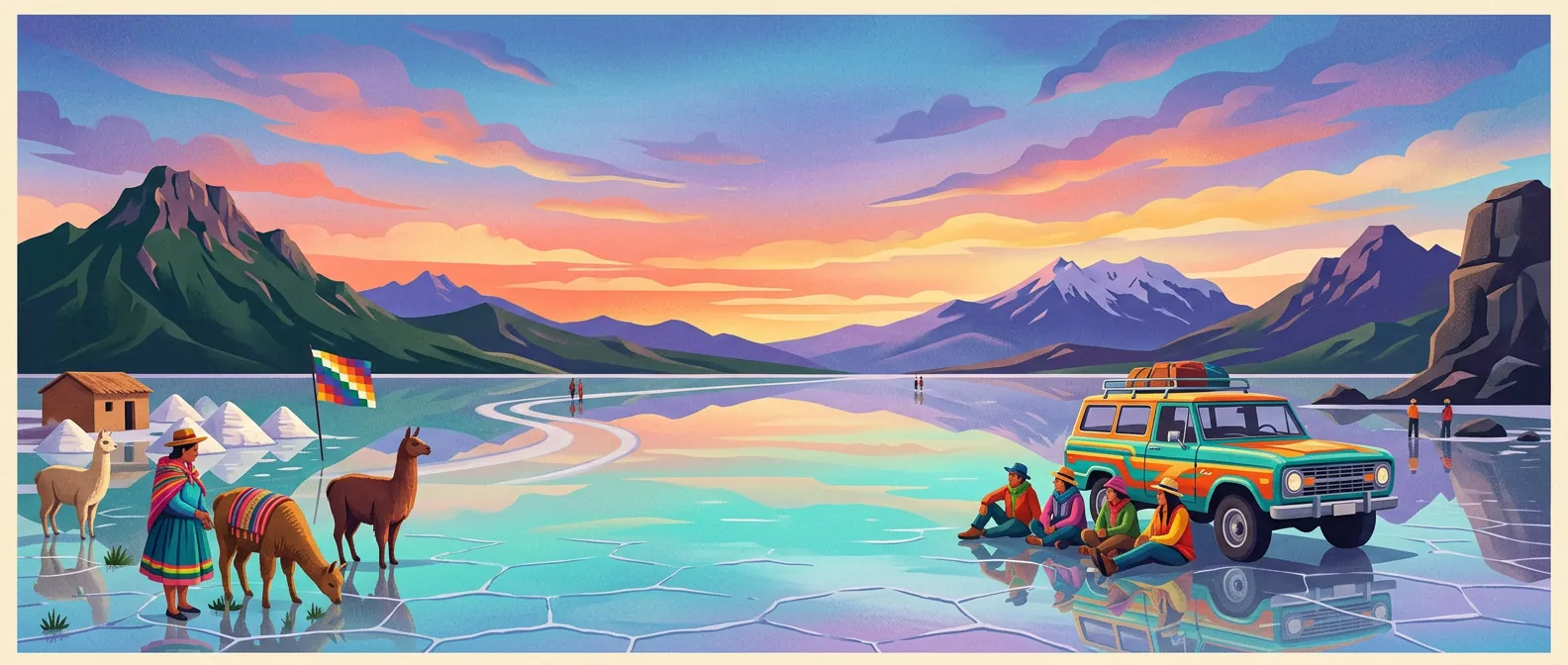
May–September is the dry season — essential for the Salar de Uyuni salt flat (the world's largest, at 10,000 sq km); in May–June the surface is dry and cracked; July–August is peak season; the wet season (November–March) creates the world-famous 'mirror effect' where a thin layer of water reflects the sky. La Paz (3,640m) requires 1–2 days acclimatisation — altitude sickness is serious at this elevation.
Tipping Customs
| Venue | Typical | Notes |
|---|---|---|
| Restaurants | 10% | Not always expected but appreciated |
| Tour guides | $5–10 USD per day | — |
Dress Code
- Warm layers for La Paz and the altiplano — temperatures drop sharply at night even in summer
- Sun protection is essential at high altitude — UV is intense
- Modest dress in markets and indigenous communities
Social Etiquette
- Bolivia has the highest percentage of indigenous population in South America — Aymara and Quechua cultures are living, not historical
- Salar de Uyuni is one of the greatest natural wonders on earth — 10,000 sq km of blinding white salt, the largest natural mirror on the planet when flooded
- The Death Road (Yungas Road, North of La Paz) was the world's most dangerous road — now a popular mountain biking descent (30km downhill from 4,650m to 1,200m)
- Lake Titicaca (on the Peru-Bolivia border) is the highest navigable lake in the world (3,812m) — the floating Uros Islands are made entirely of totora reed
Local Laws
Laws change. Verify current rules with your country's official travel advisory before departure.
- LGBTQ+ same-sex couples have some rights (since 2010) but no marriage equality; social attitudes mixed
- Drug laws strict despite Bolivia's coca-growing tradition — coca leaf (in tea or chewed) is legal and culturally important; cocaine is not
- Altitude sickness can be severe and life-threatening at extreme altitude — carry diamox and acclimatise properly
Common Phrases
| English | Local | Pronunciation |
|---|---|---|
| Hello (Spanish) | Hola / Buenos días | OH-lah / BWEH-nos JEE-ahs |
| Thank you (Spanish) | Gracias | GRAH-syahs |
| Thank you (Aymara) | Yuspagara | yoos-pah-GAH-rah |
| Thank you (Quechua) | Yusulpayki | yoo-sol-PAY-kee |
| Altitude sickness (local name) | Soroche | soh-ROH-cheh — every Bolivian traveller learns this word |
Plan Your Trip
Planning a trip to Bolivia?
Traveller builds your personalised packing list, checklist, and travel brief in seconds.
Plan this trip with Traveller